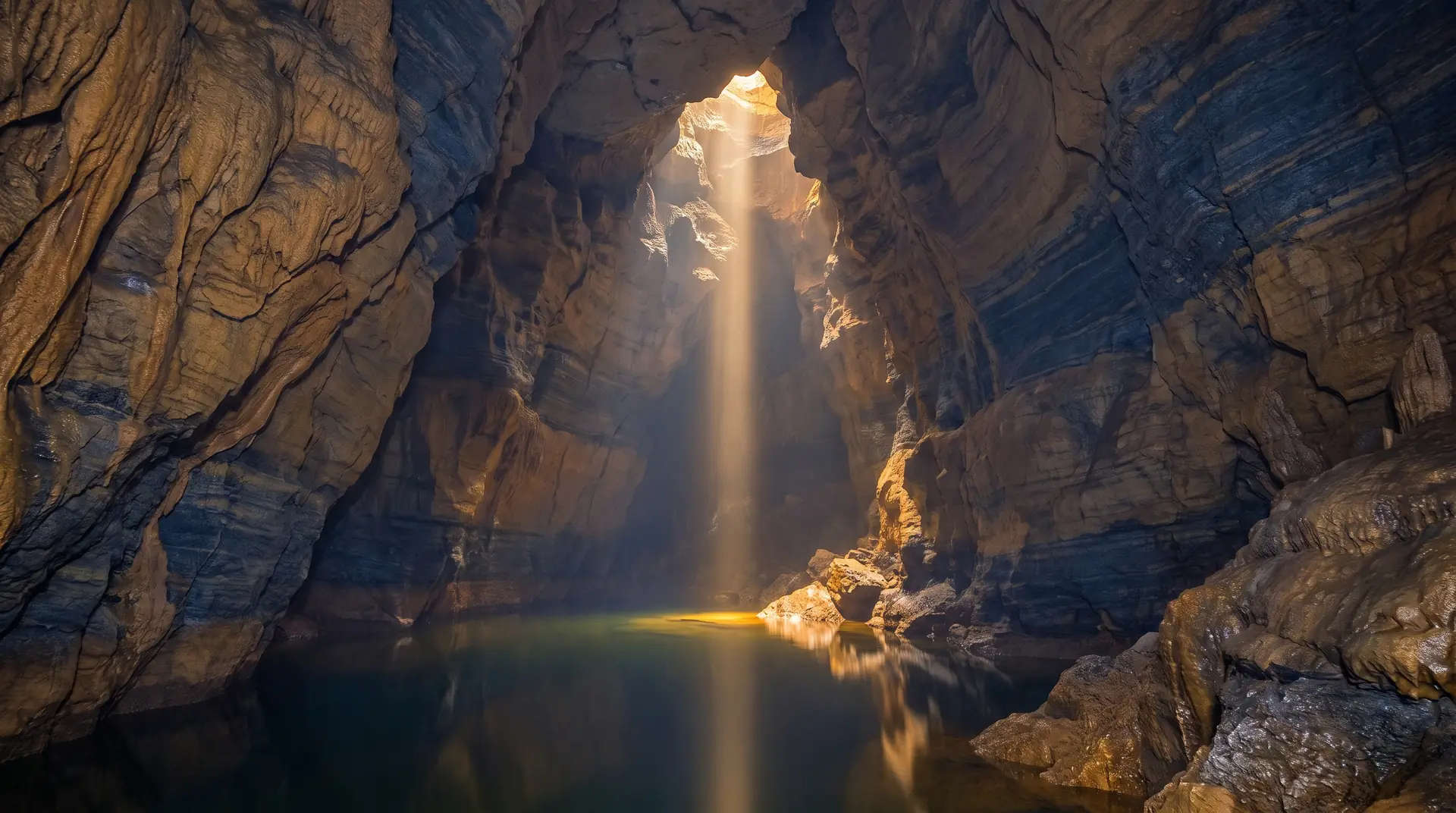
The Muskau Arch
The spring beneath
a World Heritage site
1.586 metres below the Fürst Pückler Park lies a brine that has had no contact with the surface for millions of years. Our salt comes from it – and from nowhere else.
Origin
One name, one borehole, one official recognition
Our salt does not come from "the region" or "a spring in Saxony". It comes from a single named borehole: Hy Bad Muskau 1/2000.
That borehole taps a brine 1.586 metres down which is officially recognised as a healing spring. This recognition is not a marketing claim but an administrative act: it requires the composition and mineral content of the water to be analytically documented and consistently maintained.
Geology
Why here of all places
Bad Muskau sits within the Muskau Arch, a horseshoe-shaped rock formation some 40 kilometres long. It was created when a glacier of the Elsterian glaciation pushed and folded the underlying layers upwards – which is why tertiary sands, clays and lignite seams stand almost vertically here instead of horizontally.
The Arch has been a UNESCO Global Geopark since 2011. The Fürst Pückler Park above it has been a UNESCO World Heritage Site since 2004 and, at 830 hectares, is the largest English-style landscape park in Central Europe – roughly one third on the Saxon side, the larger part on the Polish side of the river Neisse.
Two UNESCO designations above a brine spring: there is no second place in Germany like it.
The heart of it
Why no microplastics reach it
Microplastics enter the oceans through rivers, waste water and the air. Anyone evaporating sea water today also evaporates whatever is floating in it – which is exactly why studies keep finding plastic particles in sea salt.
Our brine has nothing to do with today's water cycle. It lies 1.586 metres down, enclosed between impermeable layers. There is simply no path by which a plastic particle could have got there – the deposit was sealed long before plastic existed.
The figures
The brine in brief
| Borehole | Hy Bad Muskau 1/2000 |
|---|---|
| Depth | 1.586 metres |
| Status | State-recognised healing spring |
| Salinity | About three times that of the Mediterranean |
| Location | Muskau Arch, UNESCO Global Geopark |
| Above it | Fürst Pückler Park, UNESCO World Heritage since 2004 |
Frequently asked